Synopsis

Link to our fundraiser

Synopsis

This is a fundraiser to buy equipment to launch an audio-books radio station on the FM dial and internet streaming.

Why

We look at the state of education today. Why aren’t people graduating from highschool? Why are colleges having to do remedial work? And what about the people who are the product of this system over the last few decades and are now out trying to make their living? We don’t blame teachers or administrators. Some of the best minds in the country are interested in making our education system work. But we want to do something that may help.

Would an increased familarity with classic works of literature lead to a broader interest in literacy, a better understanding of history and more appreciation for people of other places and times?

It is a sure bet that more rock/country/hip-hop/sports/political-talk on the radio, more of the same stuff playing today, leaves most of radio out. It’s just another entertainment backwater. Public radio is a great source for national news and some insightful and interesting programming.

What

We want a public-radio feel with a classic literature content. We would love to have commentary, interviews with authors, editorials which put current events in the light of history, local works, local authors… there’s a whole world out there which is waiting to be opened up.

We have a population we can serve: folks who don’t read for one reason or another, those folks who don’t go to the library and have no idea of the treasures between book covers. And there are people who are just too busy trying to keep up with the world, we’ll serve them a bit of poetry during their drive to work.

The content is ready. Volunteers have prepared an incredible resource at librivox.org.

Who

We are a husband and wife in Columbus, MS. We work. We don’t have time to save the world. But maybe we can focus enough of the random energy of humanity on our corner of the world to get this project going. We registered a non-profit corporation, Classic Book Radio with this specific goal: to improve literacy through the broadcast of classic works of literature.

We have experience in IT and radio and we love books.

You

If you are interested in radio, would like to see a new format on the air;

if you are interested in books and want other people to love them like you do;

if you are interested in education and want to help push back the dark cloud of ignorance
please contribute to our project.

Less than a week left…

Less than a week left in our crowdfunding campaign at indiegogo.com

If you have not contributed, please do so.  Even $10 or $5 will be appreciated. We’ve got a stylish T-shirt coming out, so go for the $40 level and you’ll be looking good.

Also, I’m hoping we can get someone to go for the “60 seconds about my favorit book” perk. We have a lot of time in the radio day to fill up, and I’d like to hear your voice on there.


Twitter

We participate in Twitter these days, trying to build some kind of a following.

What we hope to do is use Twitter to put out our schedule as the radio day progresses.  But that doesn’t happen yet.

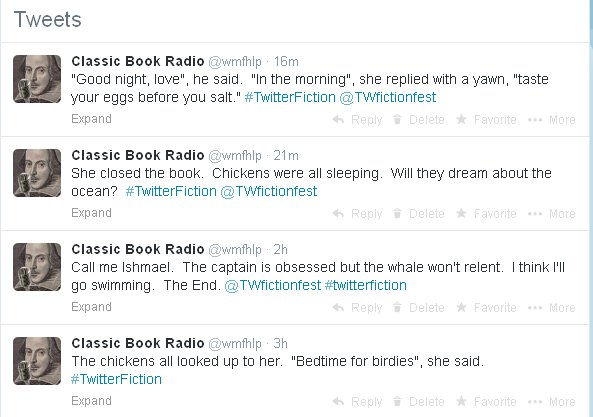
They are doing TwitterFiction today, so I put in my 2 cents (read from bottom to top):

TwitterFiction

Broadcasting Equipment

Here’s a rundown on broadcasting equipment.  Basically, there are four parts, the audio system, the radio frequency system, the automation system and the other bits.

The automation system is one or more computers which will contain our library of bits and pieces to play on the air.  Also, there is software which helps in scheduling the bits and pieces so that you don’t hear the same stuff often and other stuff never.  The automation system interfaces with the audio system through a sound card.  The computer itself doesn’t require a lot of horsepower but it is good to have business-type redundancies like disk drive mirroring or RAID.

The audio system consists of one or more microphones, a sound board or mixer, and probably a sound processing device to do compression and/or automatic gain (volume) control.  The processing device makes sure all of the stuff that comes out over the air is at about the same volume level (more or less) so that listeners don’t have to twiddle with the volume control all the time.

The radio frequency system consists of a transmitter, an antenna, and a piece of coax cable to hook the two together.  Audio from the audio processor goes into the transmitter.  The transmitter produces the radio signal which goes out to the airwaves through the antenna.

The “other bits” is a bit complicated.

The FCC requires all radio stations, no matter how big or how small, to participate in the EAS/CAP system.  This is that emergency broadcast system which you may have heard, the one with the funny tones and the “..if this were an actual emergency you would have been informed where to tune in your area for more information…”  An EAS/CAP box monitors the signals of other broadcast stations and relays the emergency message.  The CAP part monitors a FEMA web site for emergency messages.  So yes, all radio stations have to have Internet access or a good reason why not.  Believe it or not, the purpose of the EAS/CAP system is to allow the President of the United States to send out an emergency message over all broadcast media, like if we were being attacked or something.  Yes, the government can flip a switch and talk to you out of every radio and TV in the nation!  But it has never been used for that, so far.  Mostly it is used for severe weather warnings and such.

We want to get an optional box called an RDS Encoder.  RDS is that little display in your car radio which can show the name of the station and the name of the currently playing song.  We would like to use that to show the Title and Author of the work being played.

I don’t think we will need any special box for the internet streaming side of our operation.  The audio feeding into the transmitter will also go into a computer  (either the automation computer or another one) and be encoded and sent to the streaming service provider.

Finally, we will have a “monitor” radio, which is just an FM receiver to listen to our own signal.  That way we can tell if the transmitter breaks or something.